Heat: start early
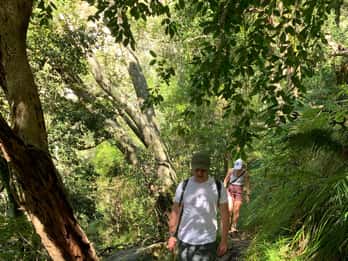
The front of Table Mountain faces north, towards the city, and gets the full sun. Platteklip Gorge, the direct route up that face, has very little shade, and on a summer afternoon it is hot work — one of the rescues reported in November 2025 was an exhausted hiker on Platteklip in the afternoon. The answer is simple: start in the morning, or take a sunrise hike and be back down before the day warms up.
On the back of the mountain, Skeleton Gorge starts in the green of Kirstenbosch garden, but water is still something to carry rather than find: one reviewer of the Skeleton Gorge hike advises staying properly hydrated and warns that in summer the water at the “beach” may be heavily drained.
Wind: the southeaster and the cable car
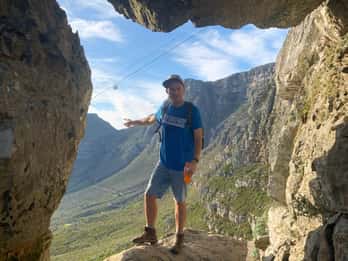
Cape Town’s summer wind is the southeaster, locally called the Cape Doctor. When it blows hard, the Table Mountain cable car stops — according to the operator on roughly 60 to 90 days a year. We have not found a month-by-month breakdown we could verify, so we do not print one. What matters for a hike: a closure can happen while you are on the mountain, and then the way down is on foot. Strong wind also makes exposed sections unpleasant, including the chains and ladders at the top of Lion’s Head. Reviews of the cable car and bus combination show what closures mean in practice: several reviewers could not ride up because the cable car was closed for high winds or bad weather.
None of the guided hikes on this site include the cable car anyway, but if you plan to ride down on your own ticket, keep enough daylight and energy for a descent on foot. Our hike or cable car page covers the details.
The tablecloth
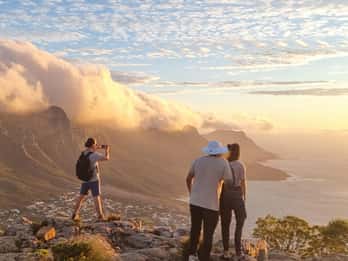
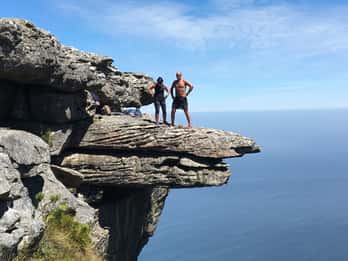
The tablecloth is the flat sheet of cloud that spills over the plateau and down the front of the mountain. It can sit on the summit while the city below is in sunshine, and from inside it there is little to see. Cloud shows up in the reviews as well: two critical reviews of one guided hike describe reaching the top with no view at all. Another reviewer walked in fog, saw nothing, and still gave five stars for the day with the guide — which says something about what a good guide adds.
!
Cloud does not stop a hike
The hikes go ahead in cloud; a grey summit is not the same as a cancelled tour. One reviewer was first told the weather was not suitable and a change of date was possible, then that it had improved — the hike went ahead and there was zero visibility at the top. Two reviews of the Lion’s Head hike with coffee describe the other side: a sunrise hike swapped for a sunset, and a group that turned back halfway and was refunded. Those are individual experiences, not published policies. Your own lever is the free cancellation up to 24 hours before the start that every hike here offers.
The best time to hike
- Time of day: morning. On the city face and on Lion’s Head, an early start avoids the worst of the heat; a sunrise hike is the early start taken to its conclusion.
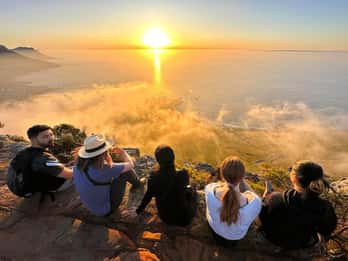
- Sunset: beautiful and busy, with the walk down in the dark — bring a head torch. Our Lion’s Head sunrise and sunset page compares the two.
- Season: the southern summer is peak season for a reason — long days and hiking weather — and the heat, the wind and the tablecloth come with it. We do not publish monthly weather statistics, because we could not verify a set to our standard.
- Your date: keep a spare day in your Cape Town plans if you can, and use the 24-hour free cancellation if the forecast turns.
What to pack for a summer hike
- More water than you think you need — especially on the north-facing routes.
- Sun protection — hat and sunscreen for the exposed city face.
- A warm layer for the summit and the wind.
- A head torch for sunrise and sunset hikes.
- Shoes with grip — trainers can slip on the rock of Lion’s Head.
★
In short
Start early, carry plenty of water, watch the southeaster in the forecast and plan the way down without relying on the cable car. The view from the top depends on the tablecloth, and the tablecloth decides on the day — a flexible date is the best protection.